
Olympia Chimney Chimney Sweep in Laguna Niguel: A Homeowner’s Guide
Most chimney quotes say “new liner” and leave it there. That tells you a price but not what’s going inside your flue. When a technician specifies an Olympia flex liner over a generic import, they’re not brand-name upselling. They’re choosing a product rated to UL 1777 and matched to the heat your wood-burning fireplace actually produces. This guide explains what Olympia-supplied components do inside a Laguna Niguel chimney, so you can read a proposal and know what you’re paying for.
If you’d rather hand the whole thing to a specialist, call (855) 594-8044. We answer 24/7. Fast dispatch from 7am to 7pm, Sunday through Friday.
What does Olympia Chimney Supply actually make?
Olympia Chimney Supply makes the parts a chimney professional installs inside and on top of your flue: flexible stainless steel liner systems, top plates and caps, bottom connectors, and the fittings that tie a liner into a firebox. That’s the plain-language version. They aren’t a hardware brand that added chimney products to a catalog; chimney systems are the whole job.
The reason technicians name them is measurable, not brand loyalty. A flex liner’s real service life comes down to three things:
- Alloy. The stainless grade determines how well the liner resists the acidic condensation that forms when wood smoke cools. A lower grade works fine in a rarely used fireplace and struggles in a heavily used one.
- Gauge. Wall thickness, expressed in gauge numbers, affects how the liner handles thermal cycling and how it holds up to a brush over years of sweeps. Thinner walls flex easily but have less material to give.
- Construction and listing. The way the seam is formed and whether the system is listed to UL 1777 as a complete assembly, not just the tube, tells you it was engineered and tested as a system.
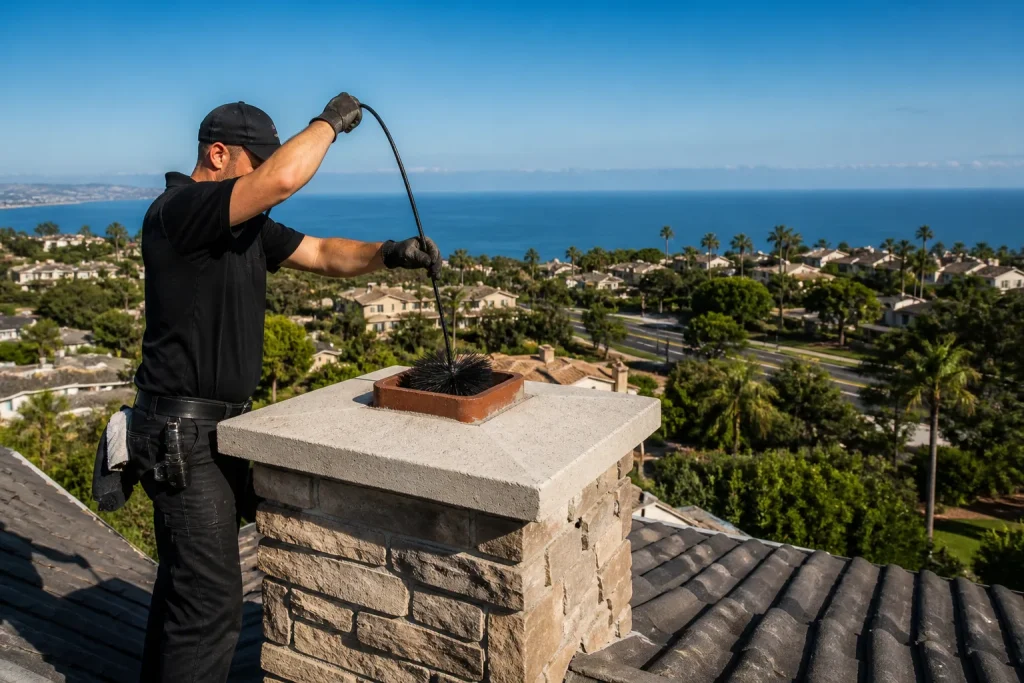
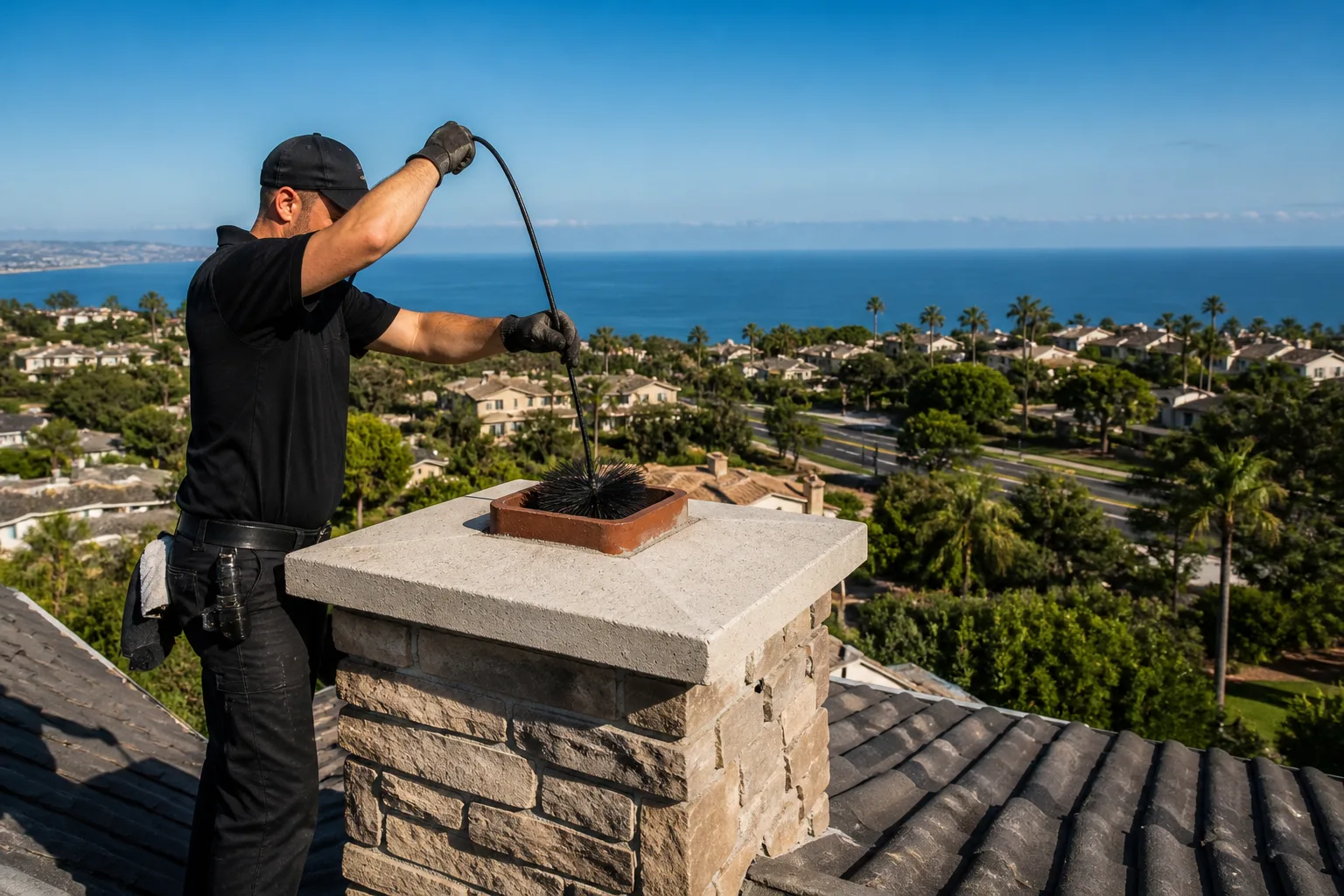
Chimney sweeps in Laguna Niguel matter to the liner question because regular sweeping is what keeps the liner’s job manageable. A flue free of heavy creosote and soot deposits heats and cools more evenly, and the liner isn’t sitting under a blanket of corrosive material between fires.
In our experience, this is the piece homeowners almost never get explained. You’ll hear “we’ll reline it,” not “the alloy grade on this model is specified for wood-burning appliances.” Ask, and a good technician will tell you. If they can’t, that’s information too.
When does a Laguna Niguel house actually need a new liner?
A liner isn’t a default upgrade. It’s a fix for a specific problem, and Laguna Niguel’s older masonry homes tend to present one of four situations. We’ll tell you what it needs, not what costs the most.
- Damaged tile liners. Original clay tiles crack, spall, and come apart at the joints. Once the flue loses its continuous interior surface, combustion gases can reach the surrounding masonry. Camera inspection shows this clearly, and you should be shown the images.
- Gas insert conversions. When a fireplace moves from wood to a gas insert, the venting requirements change. A liner sized for the new appliance does the job the old flue can’t.
- Chimneys with offsets. Some flues bend or offset on the way up. Rigid liner sections can’t navigate those bends; a flexible system can, which is where DuraFlex-type flexible products earn their place in the conversation.
- Unlined or under-lined older chimneys. A flue that never had a proper liner, or was built with an inadequate one, can’t be safely used at full duty without one.
And here’s the honest part: sometimes it’s unnecessary. If your tile liner is intact, the flue is properly sized for your appliance, and the camera shows a continuous surface, a sweep and inspection may be all you need. We’ve seen flues that only needed cleaning quoted for full relining elsewhere. That’s exactly why we inspect first and put the findings in writing.
What does professional flex liner installation involve?
An Olympia liner is a professional-grade component, and professional-grade means it’s installed to spec. The product is only as good as the installation around it. In our experience, a proper installation follows a sequence:
- Sizing. The liner is matched to the appliance and the flue’s actual dimensions, measured, not estimated. An undersized or oversized liner affects draft and performance.
- Firebox and damper prep. The damper opening and firebox connection are prepared so the liner can pass cleanly and connect at the bottom.
- The pull. The flexible liner is fed down the flue, top to bottom, and seated at the firebox.
- Top plate fitting. At the crown, a top plate is fitted to close the gap around the liner. This is a water-intrusion point, and a properly sized, manufacturer-sourced plate does that job far better than a field-fabricated patch.
- Bottom connector. The liner ties into the firebox with the correct connector, so the whole run is continuous.
- Insulation and the final inspection. Depending on the application, the liner may be wrapped with insulation, and the finished installation is inspected, ideally with a camera, to confirm it’s seated and continuous before anyone builds a fire.
Cap and crown work usually happens in the same visit, and it should. The cap is what keeps water and animals out of the flue, and a new liner under a missing or rusted cap is a job half done. We install Gelco and Famco cap and crown components because water intrusion at the top of the chimney is the leading cause of the structural damage we get called out to repair.
Because the work reaches from the firebox to the cap, one company handling both the cleaning side and the structural side keeps the story straight. There’s no handoff to a subcontractor who never saw the inspection report.
How do Olympia components compare to hardware-store materials?
The comparison isn’t marketing; it’s spec sheet against spec sheet. Here’s what actually differs when you line professional-grade components up against the generically sourced materials sometimes used to hit a low bid:
| Factor | Professional-grade system (e.g., Olympia-supplied) | Generic or field-fabricated material |
|---|---|---|
| Alloy and gauge | Specified grade and wall thickness, stated in the submittal | Often unstated; may not be available in writing |
| Listing | System listed to UL 1777 as a complete assembly | May not carry a system listing |
| Top plate and cap | Manufacturer-sourced, sized to the liner | Field-fabricated or mismatched |
| Documentation | Model number, gauge, and warranty paperwork | Often none beyond the invoice |
What this means in real service life: a correctly specified alloy at the right gauge, installed to the manufacturer’s instructions and swept regularly, is built to last through years of thermal cycling. A thinner, lower-grade, unlisted liner may work fine for a season or two and then show pitting, seam separation, or corrosion at the connector. When that happens, you’re paying for the installation twice.
The same logic applies to HeatShield resurfacing, which we can do as an alternative to a full reline when the flue damage is surface-level and the structure is sound. It restores the interior without replacing the liner, and it’s a cost-saving option most competitors never mention, probably because they can’t do it. Our technicians have up to 12 years of experience and the resurfacing capability to tell you when it’s the right call.
What should a written proposal with Olympia components show you?
This is the part that protects you. A proposal that names a product but shows no specs isn’t a proposal; it’s a price with a brand attached. Before you sign anything that includes Olympia components, confirm the written proposal gives you:
- The model number. The exact product family and model, not just “Olympia liner.”
- Gauge and alloy specs. The stainless grade and wall thickness, written out.
- Warranty documentation. The manufacturer’s warranty terms, not a verbal assurance.
- The scope in full. Liner, top plate, bottom connector, insulation if applicable, and whether cap and crown work is included or separate.
- The inspection findings. The camera images and the condition report that justify the work.
Compare that to the generic version of the same proposal, and the gap usually shows up in the documentation. If a quote can’t tell you the model and the specs, ask why, and be wary of a price that seems too good. The materials and the installation that meets listing are what you’re buying.
When to call a pro
A sweep, and especially a liner decision, is a job for a trained technician. Creosote is flammable and the flue is a confined space; a liner that isn’t sized or seated correctly can let gases reach the structure it’s meant to protect. That’s not a DIY project, and it’s not a job for whichever general handyman answered the phone. It’s a job for someone who works on chimneys every day.
If you’re in Laguna Niguel and need help, our Laguna Niguel Chimney Sweep Pros team handles the sweep and inspection that tells you what your flue actually needs. For the deeper work, we offer chimney repair for structural issues and fireplace repair for the firebox and surround. One specialist, from the firebox to the cap.
The Bottom Line
Olympia Chimney Supply products are professional-grade components, and they’re only worth the name when the installation matches the spec. A UL 1777-listed flex liner, correctly sized and installed with a manufacturer-sourced top plate and bottom connector, then inspected and swept on schedule, is built to last. A generic tube under a field-fabricated plate isn’t. The difference is in the specs, and the specs belong in your written proposal.
In Laguna Niguel, get the inspection first, look at the camera images, and ask for model numbers and gauge. If you’re in Laguna Niguel and need help, Laguna Niguel Chimney Sweep Pros offers free estimates. Call (855) 594-8044. We answer 24/7. Fast dispatch from 7am to 7pm, Sunday through Friday.
Frequently Asked Questions
A standard sweep is priced per job by a written estimate, and the estimate is free, so the first step is a call. Most proposals depend on the flue’s accessibility, the level of deposits, and whether an inspection is included. Call (855) 594-8044 for an exact quote; estimates are free.
Not always. You need one when the existing liner is cracked, spalled, unlined, under-sized for your appliance, or when a gas insert conversion requires different venting. If the camera inspection shows an intact, properly sized liner, a sweep may be all that’s needed. We don’t recommend liner work without camera evidence you can see for yourself. Call (855) 594-8044 to book an inspection and get a straight answer.
For a wood-burning fireplace in regular use, annual sweeping is the common professional standard, and a fireplace used heavily through the cooler months may benefit from more frequent checks. Sweeping on schedule is what keeps deposits from building to the point where they affect draft and safety. Call (855) 594-8044 to book your sweep.
Deposits accumulate, draft weakens, and the liner sits under a layer of corrosive material between fires. Over time that shortens the liner’s life, and in a heavily used flue, creosote buildup is a fire risk. Skipping the annual check also means a small crack or a loose cap goes unnoticed until it’s a repair. Call (855) 594-8044 for a sweep and inspection; estimates are free.
Written by the team at Laguna Niguel Chimney Sweep Pros.
Need Chimney Cleaning Help?
Call Laguna Niguel Chimney Sweep Pros - the local pro we connect you with is licensed and insured, with free written estimates in Laguna Niguel.
(855) 594-8044